 ID
 EN
 中文
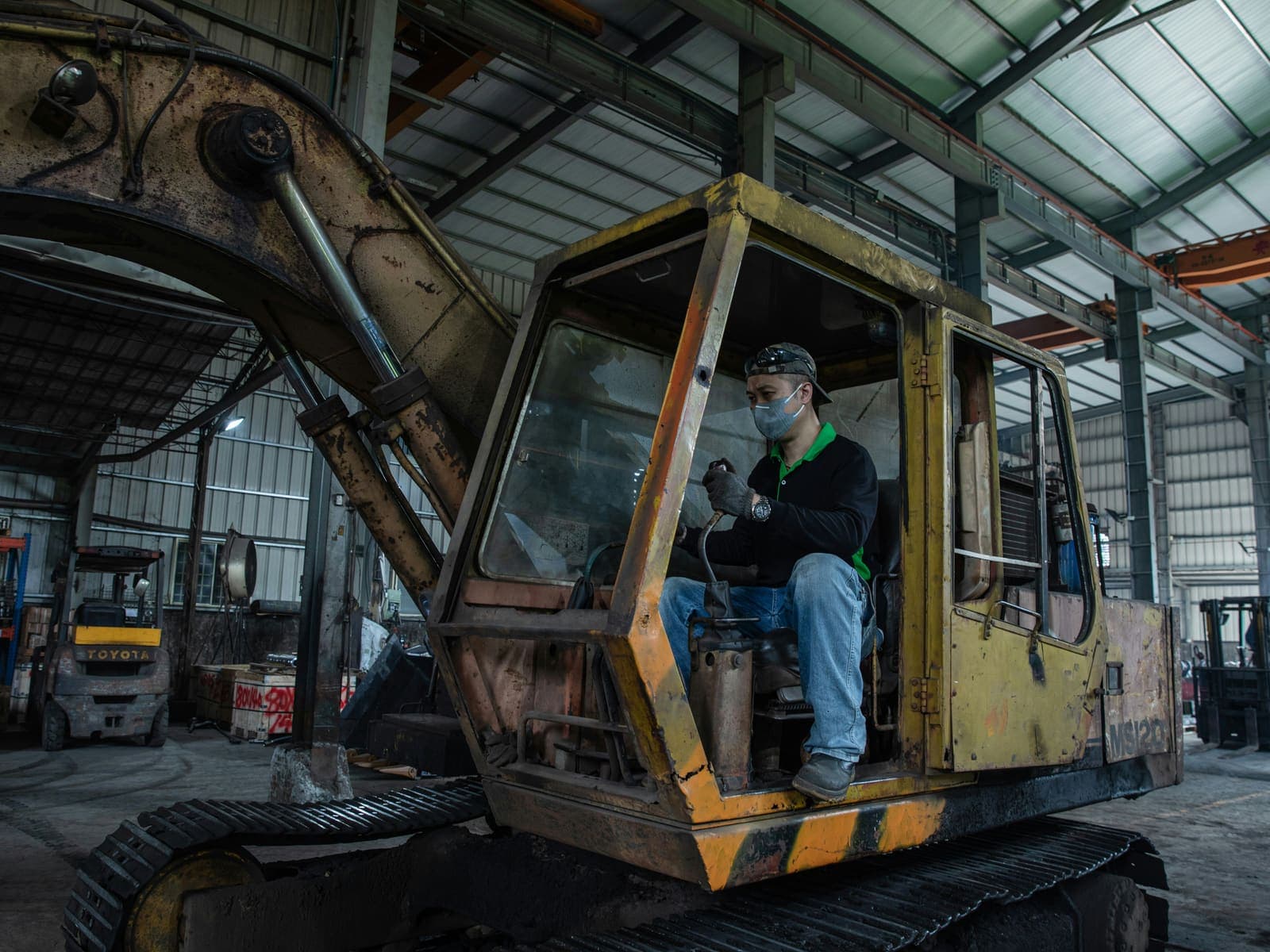
Low back pain in heavy equipment operators usually comes from three things acting together: whole-body vibration travelling from the machine into the seat, long hours sitting in one position, and jolts when the unit crosses a damaged haul road. Most cases have no specific disease behind them and settle within weeks. The first fixes are in the cab: set up the seat before moving off, cut down the jolting, and climb down to move around whenever there is a break. Go to the site clinic if the pain does not get better, and straight away if any of the warning signs listed below appear.
This article is written for dump truck, excavator, dozer, grader, and loader operators. The last section is for the HSE team.
Why are heavy equipment operators prone to low back pain?
Whole-body vibration enters the body through the seat or the cab floor, not through the hands. Burström and colleagues (2015) pooled 20 studies in a meta-analysis and found that this exposure was linked to more frequent low back pain (odds ratio 2.17) and sciatica, meaning pain that spreads down the leg (odds ratio 1.92). Workers with high vibration exposure had a pooled risk estimate of 1.5 compared with workers exposed to low levels.
Vibration is not the only factor. Article 23(2) of Indonesian Minister of Manpower Regulation 5/2018 (Permenaker 5/2018) lists unsuitable working positions and postures, and equipment design that does not match the worker's body size, as ergonomic hazards. In a cab, that can mean a seat set too far from the pedals, a body constantly twisted to watch the bucket or the tray, and hours of sitting without standing up. WHO adds other risk factors: low physical activity, smoking, obesity, and high physical strain at work.
According to WHO, about 90% of low back pain is non-specific: no particular disease or structural damage can be identified as the source. Management therefore relies on movement, lighter physical strain at work, and changes in habits.
What is the whole-body vibration limit under Permenaker 5/2018?
Article 11 of the regulation covers two kinds of vibration: hand-arm and whole-body. The whole-body figures are in the Appendix, on page 56:
| Exposure time per working day | Threshold limit value (m/s²) |
|---|---|
| 0.5 hours | 3.4644 |
| 1 hour | 2.4497 |
| 2 hours | 1.7322 |
| 4 hours | 1.2249 |
| 8 hours | 0.8661 |
The longer the daily exposure, the lower the permitted value. Article 1 point 7 defines the threshold limit value for work of no more than 8 hours a day or 40 hours a week, and the table stops at the 8-hour row. There is no figure for 10 or 12-hour shifts, so do not guess one by extending the series. Noise has the same gap, which we cover in our article on noise limits and 12-hour shifts.
For comparison, the European Union's Directive 2002/44/EC (Article 3(2)) sets an action value of 0.5 m/s² and a limit value of 1.15 m/s² for whole-body vibration, both as daily exposure normalised to an 8-hour reference period, written A(8). The Indonesian table gives a different limit for each exposure duration and does not explain how the figures are calculated, so 0.8661 and 1.15 cannot simply be compared. The European rules are not binding in Indonesia, but they show that a control programme there becomes mandatory as soon as the action value is exceeded.
What can operators do in the cab?
Article 11(4) lists ways to control vibration, including inserting damping between the equipment and the parts of the body in contact with it, and limiting exposure by managing working time. Article 23(4) adds managing work and rest periods and keeping a neutral posture. In the cab, that means:
- Set up the seat before the unit moves. If the seat suspension can be adjusted for body weight, adjust it every time the unit changes operator. Position the seat so the pedals and levers are within reach without bending forward or leaving the backrest.
- Wear the seat belt. Besides safety, it keeps your body from being thrown off the backrest when the unit jolts.
- Slow down on corrugated or potholed roads, staying within the site speed limit.
- Get out and walk during breaks, such as while queuing to load or waiting at the dump, where site procedures allow it.
- Use three points of contact getting in and out of the cab. Do not jump from the last step.
- Report damaged seats, suspension, or haul roads through the hazard reporting channel, with the unit number and location.
- Protect your sleep and rest during the roster. This is covered in our article on fatigue in roster workers.
When should back pain be checked at the site clinic?
The NHS says low back pain often gets better on its own within a few weeks. Meanwhile, keep moving and avoid long periods in bed; the NHS and NICE guideline NG59 (recommendation 1.2.1) both encourage people to carry on with normal activities.
See the site clinic if the pain has not eased after a few weeks, gets in the way of work, does not improve with rest or is worse at night, comes with weight loss you cannot explain, or there is a lump in your back. Go the same day if severe pain starts suddenly or gets worse quickly, or if you feel feverish, shivery, or generally unwell.
A few more points:
- Painkillers are not the first step. WHO says they should not be the first-line treatment and should ideally be combined with other treatments. If you need medicine, the clinic doctor chooses it and also judges whether you remain fit to operate the unit.
- Do not buy a back belt or corset yourself. NICE NG59 (1.2.3) says belts and corsets should not be offered for managing low back pain.
- An X-ray or MRI is not always needed. NICE (1.1.4) advises against routine imaging in non-specialist settings. The doctor first rules out specific causes such as infection, injury, or cancer (1.1.1), then decides whether a referral is needed.
After time off with back pain, the return to your unit goes through a fitness-for-work assessment, sometimes with temporary restrictions; see our article on fit to work for site workers.
Can an operator's low back pain be an occupational disease?
Indonesia's Presidential Regulation 7/2019 does not name low back pain specifically. Its Appendix lists diseases caused by vibration or disorders of the muscles, bones, joints, and peripheral nerves (part I, letter b, number 2), and other musculoskeletal diseases whose link to work exposure is scientifically proven (part II, letter c, number 8). Low back pain can therefore be recognised as an occupational disease if the link to work is proven. The diagnosis is made by a doctor or specialist competent in occupational health (Article 3). Reporting steps and work accident insurance (JKK) rights are covered in our article on reporting occupational diseases. Complaints recorded at the site clinic from the start help with that proof.
For HSE: what to measure, maintain, and record
- Measure per unit and per route. The vibration inspection form in the Appendix to Permenaker 5/2018 asks for the vibration source, daily exposure duration, test result, threshold limit value, controls already in place, and the measuring instrument's details and calibration date. Results above the limit must be controlled (Article 11(3)). How to measure, and the limit values for other workplace environment factors, are described in the article on workplace environment measurement under Permenaker 5/2018.
- Use the current rules. Regulation PER.13/MEN/X/2011 was revoked by Permenaker 5/2018. Replace the old tables in procedures and reports.
- Maintain seats, suspension, and haul roads. Add seat condition to unit inspections and schedule repairs for road sections that keep being reported. The EU Directive (Article 5(2)) also includes seats that reduce vibration, maintenance of equipment and workplaces, and work schedules with adequate rest in the control programme.
- Plan rotation and breaks on long shifts. Because the limit table does not reach 12 hours, rotating operators between high and low vibration units and building in breaks out of the cab are practical ways of managing working time.
- Record back complaints at the clinic by unit and route. Complaints clustering on one route or one type of unit are a reason to measure again or repair the road. Individual medical data stays confidential; HSE receives group summaries.
- Prepare a return-to-work pathway. NICE (1.2.15) calls for return to work to be promoted and facilitated. Temporary duties on a unit with lower vibration can be an option once the doctor recommends it.
Our occupational health service maps physical and ergonomic hazards, including vibration, monitors exposure, examines workers according to their risks, and prepares reports for HSE. In this service, measurements are taken with calibrated instruments; measurements that regulations require a laboratory or designated body to perform are coordinated with qualified parties. On sites with an onsite clinic, our service scope covers daily complaints handled by medical staff, referral preparation, and recording of complaint patterns for periodic reports.