ID
ID EN
EN 中文
中文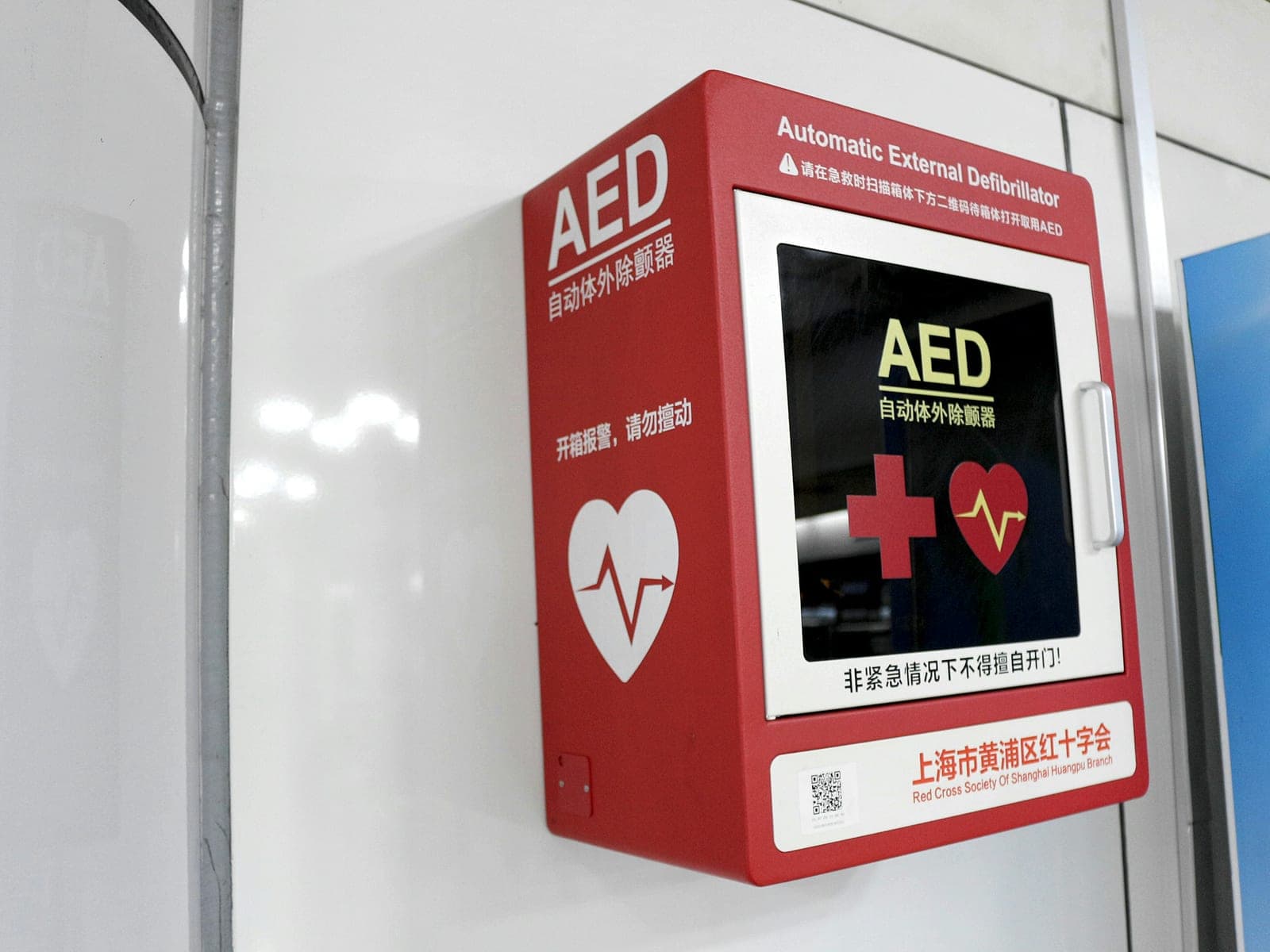
An automated external defibrillator (AED) is a portable, battery-powered device for helping someone in cardiac arrest. Pads placed on the casualty's chest let the device read the heart rhythm; it then decides whether a shock is needed and talks the rescuer through each step. On a work site, its value depends on two things: how quickly the AED reaches the casualty, and whether a trained person has already started CPR. A large site therefore needs several units close to where people work, a routine for checking batteries and pads, and trained responders on every shift. We found no Indonesian regulation that requires workplaces to have an AED, so buying one is a decision based on the site's own risk assessment.
This article is for HSE and procurement teams at mines, smelters, plantations, and construction projects far from a hospital.
Why does time matter so much in cardiac arrest?
The European Resuscitation Council (ERC) 2025 guidelines put three actions at the start of the chain of survival: early, good-quality chest compressions, effective rescue breaths, and prompt use of an AED. The ERC book for the general public says the chance of surviving an out-of-hospital cardiac arrest rises significantly when the casualty receives CPR and an AED shock early, and that each minute before defibrillation cuts that chance by 10%. The American Heart Association (AHA) 2025 adult basic life support guideline covers the same elements: recognising cardiac arrest, activating the emergency response, high-quality CPR, and AED use. The FDA's AED page also notes that CPR combined with early defibrillation works when it happens in the first few minutes after collapse.
An AED cannot shock at random. According to the ERC, it will not discharge unless it detects the right conditions. A lay rescuer only has to follow the voice prompts, while chest compressions stay the main job until the device is ready.
Do Indonesian first aid rules mention AEDs?
Indonesia's workplace first aid regulation, Minister of Manpower and Transmigration Regulation No. PER.15/MEN/VIII/2008, does not mention AEDs or defibrillators anywhere in its articles or annexes. Article 8(1) lists first aid facilities as a first aid room, first aid kits and their contents, evacuation and transport equipment, and additional facilities for special hazards, which Article 8(3) defines as safety showers and eyewash equipment. For mining, Appendix III of Minister of Energy and Mineral Resources Decree No. 1827 K/30/MEM/2018 asks companies to provide first aid personnel, facilities, equipment, and training in line with existing regulations. It does not mention AEDs either.
The practical approach is to treat an AED as a risk-based addition that sits on top of the first aid structure you already run. Article 2 of PER.15/2008 makes the employer responsible for first aiders and first aid facilities, Article 3 covers first aider licensing, and Article 5(2) requires first aiders on every shift and in each work unit 500 metres or more apart. AED points and trained responders should follow the same map. Our article on workplace first aiders shows how to count them per shift and work unit.
On device quality, the US FDA requires premarket approval for all AEDs and their necessary accessories, such as batteries, pad electrodes, and adapters. That rule applies to the US market, but the list shows which parts to check during procurement: ask the supplier to confirm that pads and batteries match your model and that replacements will stay available.
Where should AEDs go on a large site?
The ERC treats placement, access, and ease of retrieval as central to good outcomes. For public AEDs, it recommends units that are easy to reach, clearly signed, and stored in unlocked cabinets available 24 hours a day, every day. The ERC also recommends that services with a duty to respond to emergencies carry an AED in their vehicles.
One AED at the site clinic will not cover a pit, a haul road, or a plantation block several kilometres away. Work out AED points from the time it takes to bring a unit to each group of workers, then test it with a drill: how long from the radio call until the pads are on the manikin? The primary sources we read do not set a specific number of minutes, so agree a target with your site doctor and record the reasoning.
| Location | Why here |
|---|---|
| Workshop | Many workers per shift and heavy physical work |
| Control room | Staffed through every shift and the hub for radio traffic |
| Mess and canteen | Where people gather outside working hours, including at night |
| Security post | Staffed around the clock, near the gate and vehicle exits |
| Patrol vehicle or ambulance | Reaches spread-out pits, haul roads, and plantation blocks |
| Site clinic | First point of referral and home of the spare stock |
How do you keep batteries and pads ready in heat and dust?
The FDA explains that an AED system includes accessories such as the battery and pad electrodes, which the device needs to read the heart rhythm and deliver a shock. If either has expired or is damaged, the unit is not ready, even if it looks fine.
Storage temperature limits and the service life of batteries and pads vary by model, so take those figures from the manufacturer's instructions rather than from general brochures. On tropical sites the weak spots are cabinets in direct sun, vehicle cabs parked in the heat, and dusty areas such as crushers and haul roads. Choose shaded mounting points, use cabinets that keep dust out, and compare the room conditions with the manufacturer's temperature range.
A periodic checklist we suggest:
- the status light or screen shows the unit is ready, with no warning beeps;
- pad packs are sealed and within their expiry date;
- the battery is within its use-by date, and the replacement is ordered well ahead;
- the cabinet is unlocked, signage is visible, and nothing blocks access;
- the support items the manufacturer recommends are all present;
- each check is logged by serial number, with the checker's name and the date.
Make the site clinic the owner of this task. The clinic keeps a register of every AED with its serial number and location, schedules the checks, and holds the spare stock. Deliveries to remote sites can take a long time, so keep at least one spare set of pads and a spare battery for each AED model, and order replacements in line with the site's supply schedule. Our medical equipment service covers procurement, delivery to site, and routine maintenance.
Who should be trained, and how do you cover every shift?
An AED with no trained responder nearby is just a box on the wall. Train first aiders in every work unit and shift in CPR and AED use, then add people at points that are always staffed, such as control room operators and security officers. Check coverage by name against the roster. For example, on a 10 weeks on, 2 weeks off roster, the trained people on the workshop night shift may all be on leave at the same time.
The steps we train follow the ERC sequence and Indonesian Ministry of Health guidance:
- Check for a response and for breathing. Gasping is not normal breathing.
- Call for help on the site emergency channel (the Ministry of Health's public guidance gives 119 as the number), and send one person for the nearest AED.
- Start compressions in the centre of the chest, 5 to 6 cm deep, at 100 to 120 per minute.
- Switch on the AED and follow its prompts. One pad goes below the right collarbone, the other on the left side of the chest below the armpit.
- Keep clear of the casualty while the device analyses and shocks.
- After the shock, restart compressions straight away until medical staff take over.
Practice on manikins and training AEDs should be repeated on a schedule, not done once at induction. Our HSE and first aid training schedules these sessions around the roster.
What happens after the shock?
The shock is only one link. The site clinic team takes over care, stabilises the casualty, and prepares a referral to a hospital that can provide further treatment. On a remote site, the land, sea, or air evacuation route needs to be settled before any incident, including who calls the receiving hospital. We describe the clinic's role in this chain in our article on the mine site clinic.
Afterwards, the clinic replaces the used pads, checks the battery, returns the AED to its point, and logs the event. If the model stores an event record, follow the manufacturer's instructions to retrieve it for the treating doctor. Review the real response time as well: how many minutes did it take for the AED to arrive, and does the point need to move?