ID
ID EN
EN 中文
中文
In Indonesia, an employer reports a work accident in two stages. The stage I report goes to the provincial manpower office (Dinas Provinsi) or the local labour inspection unit, and to BPJS Ketenagakerjaan, the state employment social security agency, within 2 x 24 hours of the accident. The stage II report goes to the same recipients within 2 x 24 hours after a doctor declares the worker recovered, disabled, or deceased, and it doubles as the claim for Work Accident Benefit (Jaminan Kecelakaan Kerja, JKK). If the stage I report is late, the employer carries the JKK benefit first. Mining operations have a third channel under the mining safety guidelines.
This article is for HSE, HR, and site management; contribution rates and the occupational disease process are not covered.
Where does a work accident have to be reported?
Several regulations apply at the same time:
| Channel | Legal basis | Deadline | Notes |
|---|---|---|---|
| Manpower authority | Law 1/1970 Article 11; Regulation PER.03/MEN/1998 Articles 2 to 4 | 2 x 24 hours from the accident | Form 3 KK2 A; a verbal report may come first |
| Dinas Provinsi or labour inspection unit, and BPJS Ketenagakerjaan | Regulation 5/2021 as amended by Regulation 1/2025, Article 8 | 2 x 24 hours from the accident | Stage I report, online or offline |
| Mining safety system (mines only) | ESDM Decree 1827 K/30/MEM/2018, Attachment III | Immediately after the event | Entered in the mine accident register, investigated within 2 x 24 hours |
PER.03/MEN/1998 covers more than JKK. Besides work accidents, it requires reports of fires, explosions, waste disposal hazards, and other dangerous occurrences (Article 2). The duty also applies to employers who have not yet enrolled their workers in social security (Article 3). As of 25 September 2026, the Ministry of Manpower's legal database (JDIH) still lists it as in force.
Article 5 of PER.03/MEN/1998 still points to social security procedures from 1993. For JKK, the procedure used today is Regulation 5/2021 as amended by Regulation 1/2025. BPJS Ketenagakerjaan's Form 3 KK1 includes a second copy for the local manpower office. Ask the office in your area whether that copy is enough, or whether it still wants a separate Form 3 KK2 A.
In mining, Decree 1827 requires accidents and dangerous occurrences to be reported immediately after they happen. Injuries are entered in the mine accident register as minor, serious, or fatal, and the mine manager (Kepala Teknik Tambang, KTT) or the technical and environmental manager (PTL) investigates within no more than 2 x 24 hours.
What goes into the stage I report?
The stage I report uses the form set by BPJS Ketenagakerjaan. The PDF on its official site, Form 3 KK1, asks for:
- employer and participant details, including a passport number for foreign workers;
- the participant's wage at the time of the accident;
- address, date, and time of the accident;
- a description of what happened and the resulting injury;
- first aid given: type of health facility (the PLKK network, or a hospital or clinic without a cooperation agreement) and transport by land, river or lake, sea, or air.
Attach copies of the participant card and the ID card or passport. For traffic accidents, the form asks for a police report or a chronology known to two witnesses.
The same 2 x 24 hour limit also runs from the date an occupational disease is diagnosed (Article 8(2)).
Regulation 1/2025 also covers reports of a suspected work accident (Article 8B). Until the status is decided, BPJS Ketenagakerjaan guarantees treatment at cooperating facilities (Article 8E) and must reach its conclusion within 30 days of receiving the stage I report, in line with Government Regulation 49/2023 Article 25A. If the event is found not to be a work accident, coverage moves to BPJS Kesehatan, the national health insurer (Article 8F).
What happens if the report is late?
Article 8(2a), inserted by Regulation 1/2025, says that once the 2 x 24 hour limit has passed, the JKK benefit becomes the employer's obligation. The employer can only ask BPJS Ketenagakerjaan for reimbursement after submitting the report (Article 8(2b)), and reimbursement follows the applicable rules (Article 8(2c)).
At remote sites, late reports usually come from lost signal, a roster change in the middle of a case, or the usual reporter being on leave. Breaching the PER.03/MEN/1998 reporting duty also carries a penalty under Article 15(2) of Law 1/1970 (PER.03/MEN/1998 Article 12).
Which accidents does JKK cover for site workers?
Article 7 of Regulation 5/2021, as amended by Regulation 1/2025, reaches beyond accidents at the workplace. It includes travel between home and work, assignments or business trips, sudden death at the workplace, and physical violence or rape connected with employment. A worker who has an attack of illness while working and dies in a health facility within 24 hours also counts as a sudden death.
Other situations close to site work patterns, with the evidence required:
| Situation | Evidence required |
|---|---|
| Travel to and from a base camp or offshore platform to the worker's home for rest (paragraph 9(d)) | Company statement and work schedule |
| Accident during overtime (paragraph 9(a)) | Overtime order |
| Assignment or business trip (paragraph 2(c)) | Work order or assignment letter, plus a police statement or witnesses |
| Travel between home and work, urgent matters (paragraph 2(b) and (d)) | Police statement, a witness to the event, or another relevant witness |
For cases under points (a) to (d), there must be physical harm shown by a wound, injury, or other evidence on the body (paragraph 3). The first examination record from the site clinic serves as that evidence.
What is attached to the stage II report and the JKK claim?
Article 19 requires the stage II report within 2 x 24 hours after the worker is declared recovered, disabled, or deceased on the basis of a doctor's certificate. The certificate states one of these: the period of temporary inability to work has ended, total permanent disability, partial anatomical disability, partial functional disability, or death. The report is also the JKK claim, with these attachments:
- BPJS Ketenagakerjaan participant card;
- ID card or other proof of identity;
- certificate from the Examining Doctor and/or Advisory Doctor;
- transport receipts;
- treatment and/or care receipts;
- other supporting documents for the type of case.
The Examining Doctor (Dokter Pemeriksa) is the doctor who examines and/or treats the worker (Article 1 point 34). Treatment receipts from facilities without a BPJS Ketenagakerjaan agreement can be submitted for reimbursement (Article 19(4)). If documents are incomplete, BPJS Ketenagakerjaan must tell the employer within 3 working days of receiving the stage II report.
Under Government Regulation 44/2015 Article 25, as amended by Government Regulation 82/2019, JKK benefits consist of medical care as needed and cash benefits. The cash benefits include reimbursement of transport to a hospital or home, first aid, and referral to another hospital. The amounts are set out in Attachment III of Government Regulation 82/2019. The right to claim lapses 5 years after the accident (Article 26).
If a labour inspector examines the case, the documents reviewed include the chronology, witness statements, and a sketch of the accident location (Article 15).
How can the site clinic prepare evidence from the first hour?
Every channel asks the same questions: when, where, who saw it, and where the patient was taken. What we recommend:
- One chronology sheet. The site clinic records the time of the accident, location, witnesses, first aid given, time of referral, and receiving facility. The same sheet feeds the manpower office report, the BPJS Ketenagakerjaan report, and the mine accident register, so the versions match. Entries in the first aider's activity log are a good source.
- A map of cooperating facilities. List the hospitals and clinics in the BPJS Ketenagakerjaan network along the referral route before anything happens, together with the medical evacuation plan.
- Receipts and assignment letters. Keep receipts for the speedboat, charter flight, or ambulance, and the assignment letter and roster schedule showing the worker was travelling for work.
- A reporter for every shift. Name one reporter and one backup per shift, with phone numbers and accounts that still work during crew change.
- Doctor's certificate for stage II. The certificate comes from the doctor who examined or treated the worker. The site clinic keeps the initial medical record and a copy of the referral letter.
The same case file serves the SMK3 audit, which asks for records of accident compensation and health rehabilitation (criterion 10.1.4 in our article on SMK3 under PP 50/2012).
ADR Medika does not handle JKK claims on behalf of companies. The employer still prepares, signs, and sends the reports.
How do you rehearse the reporting flow before an accident?
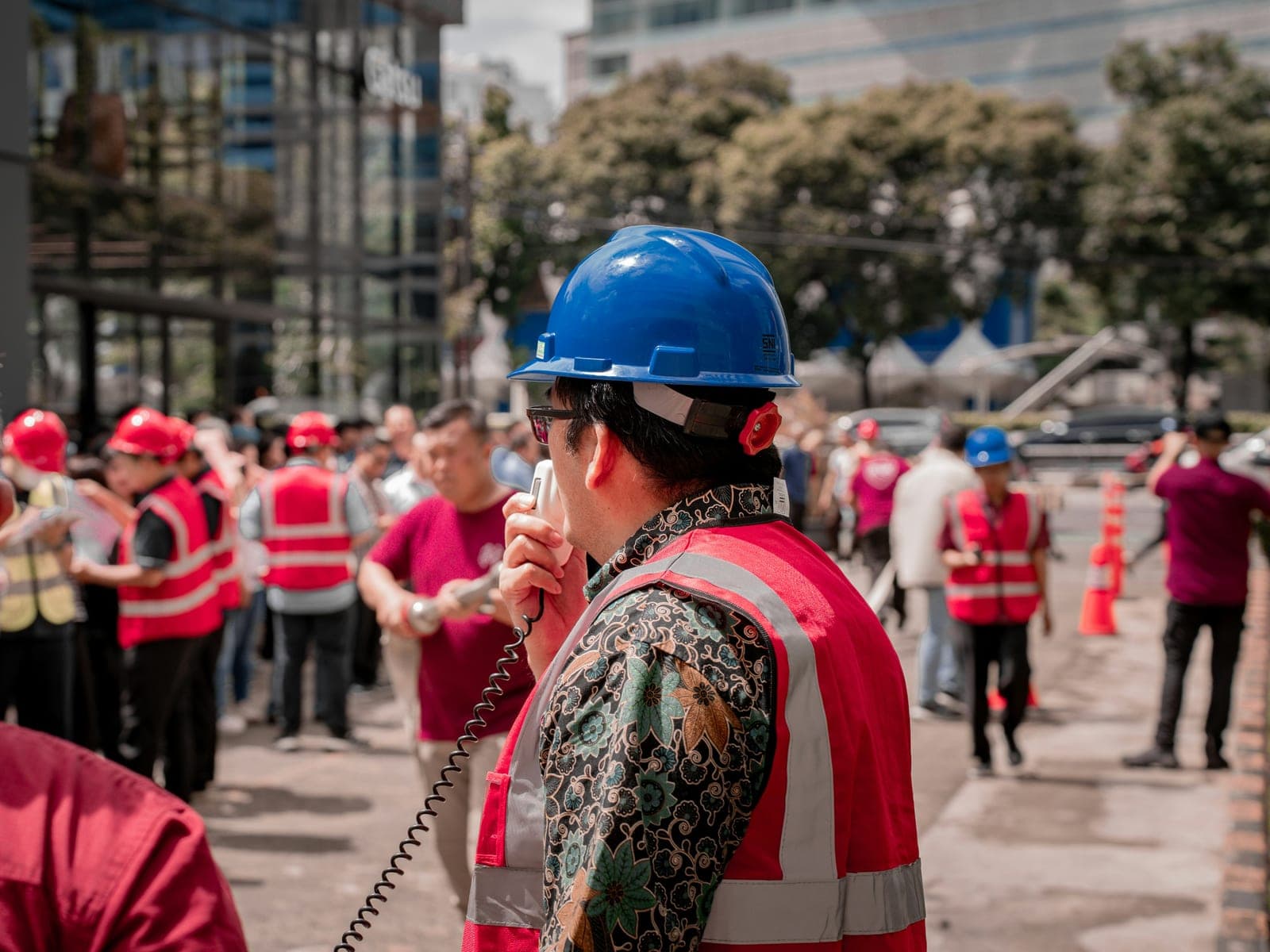
Add the reporting step to your emergency drill scenarios: who fills in the chronology sheet, what time the stage I report goes out, and what happens when the main reporter is off roster. Field supervisors need to know which evidence to secure before the area is cleaned up, including witness names and photos of the location.
Medical emergency drills and supervisor training like this are part of our K3 training service, adapted to your referral route and roster pattern.