 ID
 EN
 中文

A medical emergency response plan is a document plus drills that answer four questions: who acts first, who decides and makes the calls, where the patient goes, and when the flow was last tested. No single Indonesian regulation is called a "medical emergency response plan". The duties are spread across Law 1/1970, Government Regulation 50/2012, Manpower Ministerial Decree 186/1999 for fire, and, in mining, Energy Ministry Decree 1827 K/30/MEM/2018. Our opinion is that the safest way to read them is to merge all of those duties into one plan whose medical side has names, phone numbers, and drill results.
This article is for HSE teams, site management, and medical teams who write or update an emergency response plan. Clinical treatment is not covered. Other regulations in this field are mapped in the map of occupational health regulations in Indonesia.
What is the legal basis for a workplace emergency response plan?
The basis comes in layers, from the statute to sector guidelines. Each rule asks for something different and covers a different scope, so they need to be read side by side.
| Rule | What it requires | Notes |
|---|---|---|
| Law 1/1970 Article 3(1)(b), (d), (e) | Prevent and extinguish fire, give ways to escape in a fire or other dangerous event, and give help in accidents | General aims that lower rules spell out |
| Government Regulation 50/2012 Article 11(2)(g) and (h) | Efforts to deal with emergencies from accidents and industrial disasters, plus an emergency plan and recovery | Based on hazard potential, investigation, and accident analysis (paragraph 4) |
| Government Regulation 50/2012 Annex I letter C item 7 | A procedure covering first aid personnel and facilities in sufficient number until medical help arrives, and the further-care process | Tested periodically by competent personnel; for major hazard installations, coordinated with the competent authority |
| Manpower Decree 186/1999 Article 2(2)(f) | A fire emergency plan book | For workplaces with more than 50 workers and/or medium and high fire hazard; fire only |
| Energy Ministry Decree 1827 Annex III letter A item 1 letter f | Emergency management: identification, prevention, preparedness, response, recovery | Mineral and coal mining only |
Two points need clarifying. Decree 186/1999 requires a plan book only for fire, not for medical accidents in general. And Government Regulation 50/2012 Article 5(2) makes the SMK3 (OHS management system) mandatory for companies with at least 100 workers or high hazard potential, so the emergency procedure duty in its annex follows that threshold. Smaller workplaces are still bound by Law 1/1970, but we found no worker-count threshold for a non-fire emergency plan in the texts we read. Ask the local labour inspector if your site falls below that threshold.
Decree 186/1999 was listed as in force on TemanK3, the Ministry of Manpower portal, when we checked. A summary of the SMK3 and its response chain is in the SMK3 under Government Regulation 50/2012.
What goes into the medical side of an emergency response plan?
A plan that can be tested has seven components. The basis column only points to the part that asks for each component; the order and format of the document are Practical advice.
| Component | Minimum content | Basis |
|---|---|---|
| Emergency scenarios | A list of possible events, from a single injury to mass casualties, based on the site hazard identification | Gov. Reg. 50/2012 Annex II item 6.7.1; Energy Decree 1827, identification and assessment element |
| Organisation and roles | Who leads, who the first aiders are, who is the doctor or nurse on duty, who stands in | Gov. Reg. 50/2012 Annex II 6.7.4; Energy Decree 1827 Annex IV item 3 letter h (Emergency Response Team) |
| Alarms and communication | Alarm, radio or phone channel, clearly posted numbers | Gov. Reg. 50/2012 Annex II 6.7.5 and 6.7.6 |
| First aid facilities and clinic | Officers, first aid boxes, a first aid room where required, evacuation equipment, vehicle | PER.15/2008 Articles 8 to 11 |
| Evacuation and assembly point | Exit routes, assembly point, headcount method, ambulance route | Law 1/1970 Article 3(1)(d); Decree 186/1999 Article 2(2)(b) |
| Referral | Destination hospital by case type, transport mode, 24-hour contacts | Gov. Reg. 50/2012 Annex I C.7 letter b (further care); Health Reg. 47/2018 Article 8 |
| Recovery and reporting | Recording the event, reports, follow-up, support for affected workers | Gov. Reg. 50/2012 Article 13(2)(a) (accident reporting procedure) and Annex I C.8; Energy Decree 1827 Annex III letter A item 1 letter f (recovery element) |
For box contents, officer numbers, and first aid rooms, see first aid box contents under the Manpower Regulation and first aid officers at the workplace. Our job here is to link them together, not to repeat their numbers. For toxic gas exposure scenarios on site, see H2S gas hazards at work.
Who does what when an emergency happens?
Written roles prevent two classic failures: everyone calls the clinic, or no one does. The roles below come from the rules we read, plus one role we suggest.
| Role | Medical-side duty | Basis |
|---|---|---|
| Pengurus or employer | Provide first aid officers and facilities, carry out first aid | PER.15/2008 Article 2(1) and (2) |
| First aid officer | Give aid, maintain facilities, record in the activity book, report to the pengurus | PER.15/2008 Article 6 |
| Fire control team (regu) | Give first aid in accidents and help compile the plan book | Decree 186/1999 Article 8(1)(h) and (d) |
| Fire role officers | Put out early fires, direct evacuation, coordinate with agencies | Decree 186/1999 Article 7(1) |
| Clinic doctor in charge | Responsible for emergency services at the clinic, determines whether a patient meets the emergency criteria | Health Reg. 47/2018 Article 12(1) to (3) |
| Emergency Response Team | Appointed within the mine safety organisation | Energy Decree 1827 Annex IV item 3 letter h |
| Field lead (Practical advice) | One person who holds operational decisions on site until site management takes over | Not set out separately; Decree 186/1999 Articles 9 and 10 say the coordinator leads fire fighting until outside help arrives |
Two points are often missed. First, under PER.15/2008 Article 3(2)(a) a first aid officer must work at the company concerned to obtain a licence, so the officer list should show who works for whom. Second, Article 5(2) asks the pengurus to ensure first aid officers are present in units 500 metres or more apart, on different floors, and on every shift. A plan that only says "first aid officer" without shift and area is not finished.
How does the flow run from the event to the referral facility?
The flow below only shows how responsibility is divided. Medical actions are governed by clinical protocols, not by the emergency response plan.
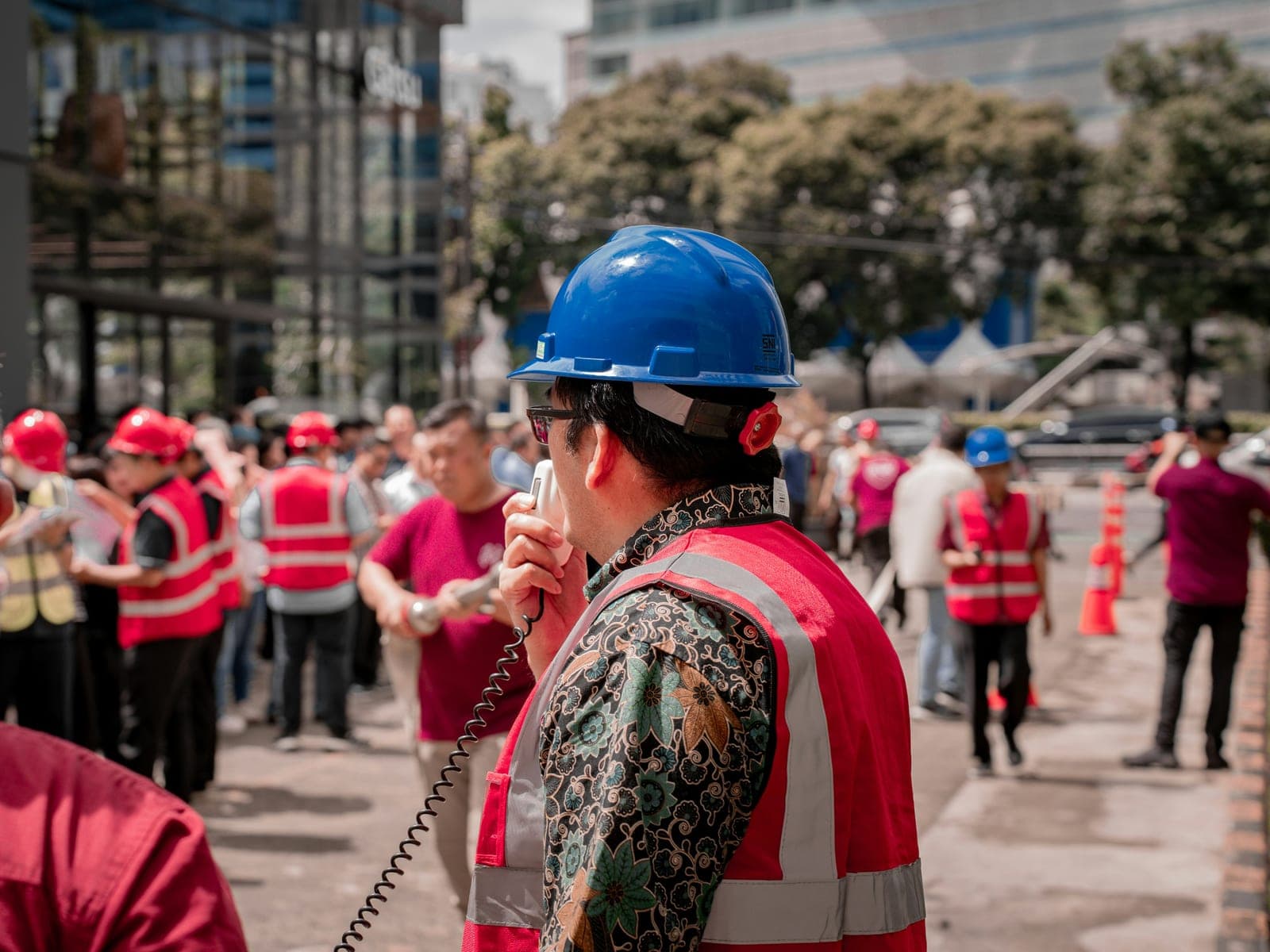
- The event is reported by alarm or radio to the control room with location, number of casualties, and the state of the area.
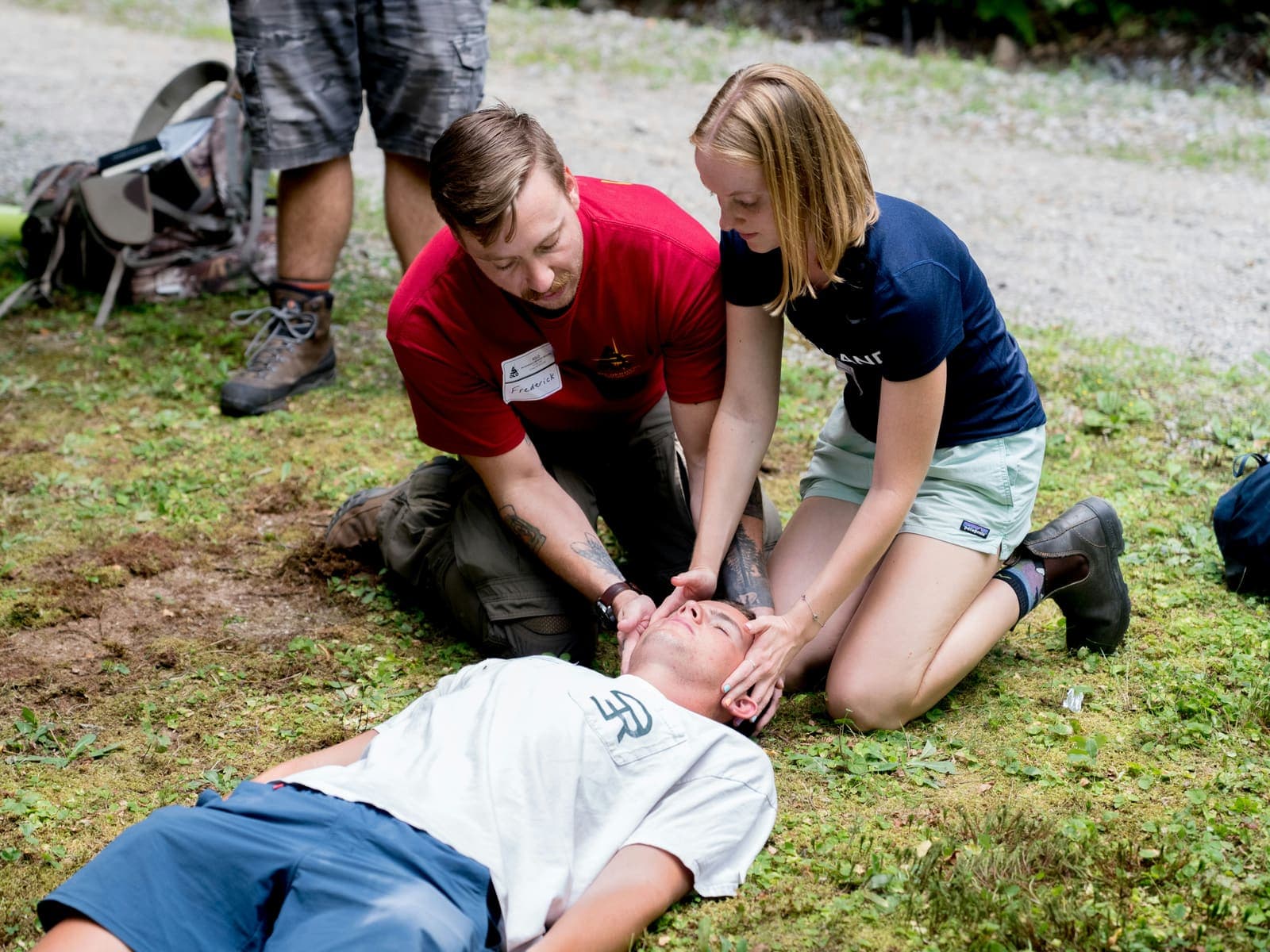
- First aiders and the team on site make sure the area is safe and give first aid. Evacuation equipment such as a stretcher is provided under PER.15/2008 Article 11.
- The clinic is notified and the doctor in charge decides whether the case needs treatment at the clinic or direct referral.
- The casualty is moved to the clinic or a pickup point. Health Reg. 47/2018 Article 5(3) and (4) say medical evacuation uses an ambulance, or other transport nearby when no ambulance is available, while keeping up resuscitation and stabilisation.
- The clinic contacts the destination hospital and prepares the referral documents; Health Reg. 47/2018 Article 8 describes referral as moving a patient to a more capable facility.
- The control room records the time of each step, then reports the event as required by reporting duties.
Details of steps 4 and 5, from stabilisation to escorts, are in medical evacuation from remote sites. Ambulance requirements are in site ambulance standards.
What is the role of the clinic and medical team in the plan?
The clinic is the midpoint between first aiders and the hospital. Health Reg. 47/2018 Article 6 requires every health facility, clinics included, to handle intra-facility and inter-facility emergencies. Articles 10 and 11 ask for human resources and facilities suited to the type of facility, with doctors, nurses, and other health workers competent in emergencies.
The limits should be written down. The medical team does not lead fire fighting and does not replace first aiders in areas far from the clinic. Likewise, first aiders do not decide on referral. Our opinion is that a clear plan states who collects the patient on site, who keeps the clinic running meanwhile, and who stands in if the duty doctor goes along. Staffing by roster is covered in medical staffing for rosters.
What does a drill that tests medical readiness look like?
Government Regulation 50/2012 Annex I letter C item 7 requires the emergency procedure to be tested periodically by competent personnel. Decree 186/1999 Article 2(2)(e) asks for periodic fire fighting drills and exercises. The rules we read do not set a frequency, so the interval is set by the company and written into the plan.
Three kinds of test, from lightest:
| Test type | What it checks | What to record |
|---|---|---|
| Tabletop | Whether every role knows its job and the numbers are still valid | List of gaps and owners of fixes |
| Communication test | Time from report to clinic answering, including outside office hours | Time per step |
| Field drill | First aid, moving the casualty, handover to the clinic, hospital contact | Times, equipment problems, and fit with the plan |
Practical advice: run drills on the night shift and at roster changes, because gaps usually appear there. Include contractors and visitors, since Law 1/1970 Article 13 requires anyone entering a workplace to obey safety instructions. Occupational health requirements for contractors are covered in occupational health for contractors and subcontractors on site. Every drill ends with a written evaluation, then the plan is updated.
Checklist for the medical side of the plan
- Site emergency scenarios are written and based on hazard identification.
- One field lead and a stand-in are named per shift.
- First aid officers are listed per area and shift, with licence and employing company.
- The doctor in charge of emergency services at the clinic is designated.
- Alarm, radio, clinic, ambulance, and destination hospital numbers are posted clearly and checked regularly.
- Assembly points and ambulance routes are drawn on the site plan.
- Destination hospital, transport mode, and 24-hour contacts exist per case type.
- Evacuation equipment and vehicles are inspected and logged.
- Drill schedule, results, and fixes are documented.
- The plan is communicated to workers, contractors, and visitors.
Common mistakes
- Treating the fire plan book as enough. Decree 186/1999 covers fire only, while Government Regulation 50/2012 asks for procedures for accidents and industrial disasters.
- A contact list that is never tested. A changed ambulance operator or hospital number is only discovered during the event.
- Roles written as job titles, not names per shift. When the roster changes, no one knows who is on duty.
- Drills only for permanent staff. Contractors and visitors are affected too, but do not know the assembly point.
- No time records. Without time per step, improvements rest on impressions.
- Not updating the plan after changes. A new road, a new camp, a new operator, or a hospital that stops accepting referrals all change the plan.
Frequently asked questions
Must an emergency response plan be written? Government Regulation 50/2012 Annex II item 6.7.1 asks for emergency procedures to be documented and communicated to everyone at the workplace, and Decree 186/1999 requires a fire plan book for the criteria described above. Other document formats follow the needs of the site.
Must the clinic be involved? We found no article that names the company clinic in the emergency response plan specifically. Health Reg. 47/2018 Article 6 requires clinics to handle emergencies, and Government Regulation 50/2012 asks for further care to be part of the procedure. Our opinion is that if the site has a clinic, involving it is the most sensible way to meet both.
Who writes the plan? The employer or pengurus is responsible. Drafting usually involves HSE, the medical team, and the P2K3 committee; the P2K3's structure and duties are in the P2K3 under Manpower Regulation 13/2025.
How can ADR Medika help?
Through our OHS training service, we help draft and train the medical emergency flow: who gives first aid, who calls the clinic or ambulance, evacuation routes, and coordination with referral facilities. Drills run with the site team and are then evaluated to improve the procedure. Our training does not replace medical staff on site.